
Journal · Planning
How to plan your year — a calm 2027 planning ritual for one evening
Plan 2027 in one quiet evening: look back at this year, choose a word, set three goals, map key dates and schedule check-ins. A simple 6-step ritual.
November 2, 2026 · 5 min read
 Save
November is the quiet sweet spot for year planning. The holidays are not here yet, there is still time to finish a few things in 2026, and January will not catch you with an empty page.
You do not need a weekend retreat or a vision board workshop. One evening, a warm drink and six steps are enough to start 2027 with a plan that feels like yours.
Before you start
Block two hours in your calendar and treat it like an appointment. Have three things open: this year's calendar (or planner), your photos from the year, and a fresh page for 2027. Phone on silent, notifications off.
Work in this order. Each step feeds the next one, and the plan stays small because of it.
Step 1. Look back at 2026 (30 minutes)
Scroll through your calendar and your photos month by month. Then answer four questions in writing:
- What am I proud of? List at least five things, big and small.
- What drained me? People, habits, commitments, routines.
- What did I keep postponing? Be honest — these are clues.
- What do I want more of next year? And what less of?
The point is not to grade the year. It is to notice patterns. If "I was exhausted every March" shows up, that is useful information for planning 2027.
Step 2. Choose a word for the year (10 minutes)
A word of the year works like a compass when there are too many options. Look at your answers from step 1 and pick one word that describes how you want 2027 to feel: calm, steady, brave, light, home, health.
Write it somewhere you will see it often — the first page of your planner is perfect. When you are unsure whether to say yes to something, ask: does this fit my word?
Step 3. Pick no more than three goals (30 minutes)
This is where most year plans go wrong: ten resolutions, all urgent, all forgotten by February. Three goals is plenty.
To choose them, look at the main areas of life: health, career, money, love, friends and family, growth, fun and rest, home. Score each one from 1 to 10 for how it feels now, and where you would like it to be. Then pick the two or three areas where the gap matters most to you.
For every goal, write three lines:
- The goal — concrete and measurable. "Run 5k without stopping", not "get fit".
- The first step — something you can do this week, in under 30 minutes.
- By when — a month, not "someday".
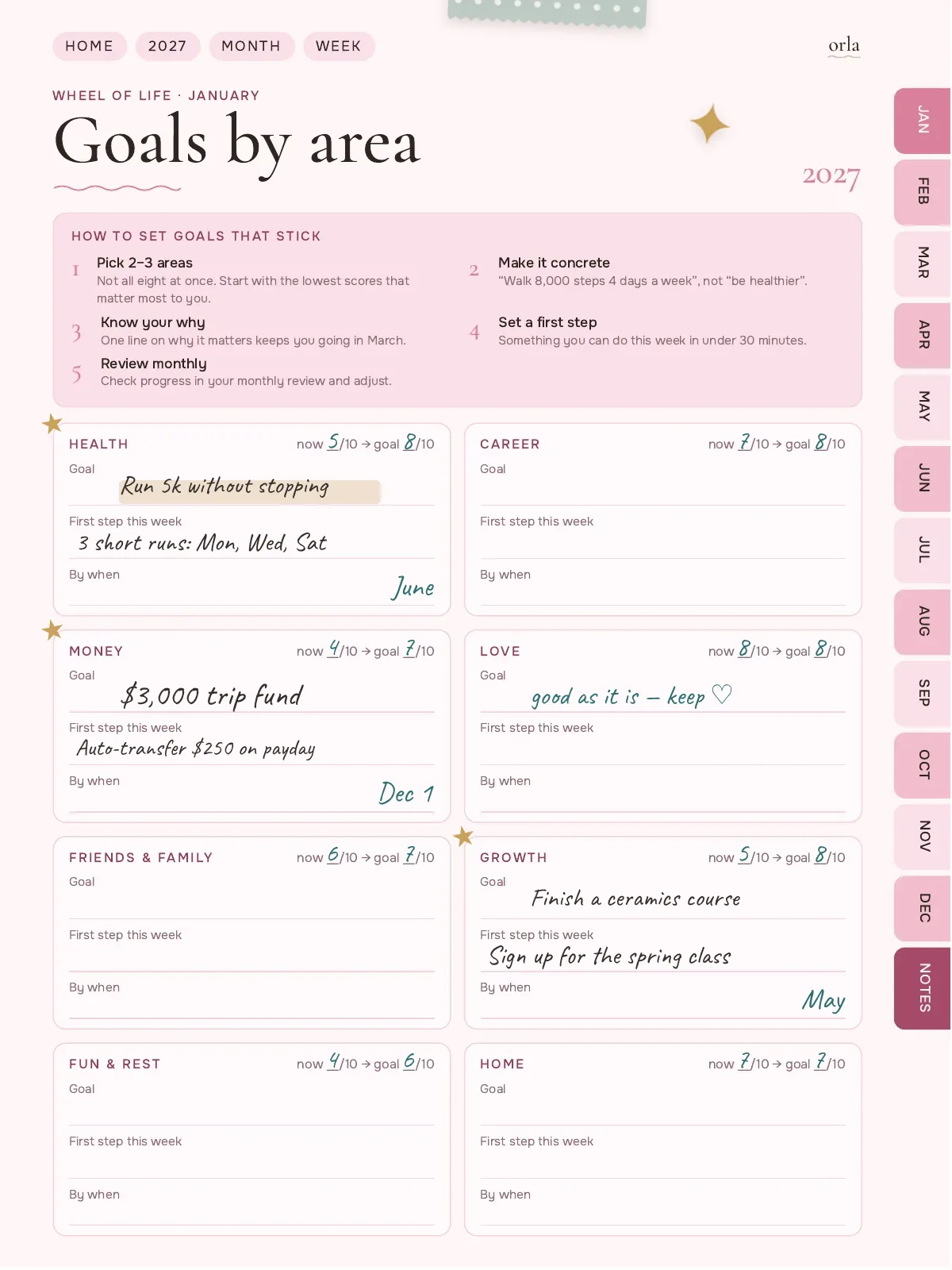
The other areas still matter. Some simply need care, not a project. A note like "good as it is — keep" is a perfectly valid plan.
Step 4. Map the year on one page (20 minutes)
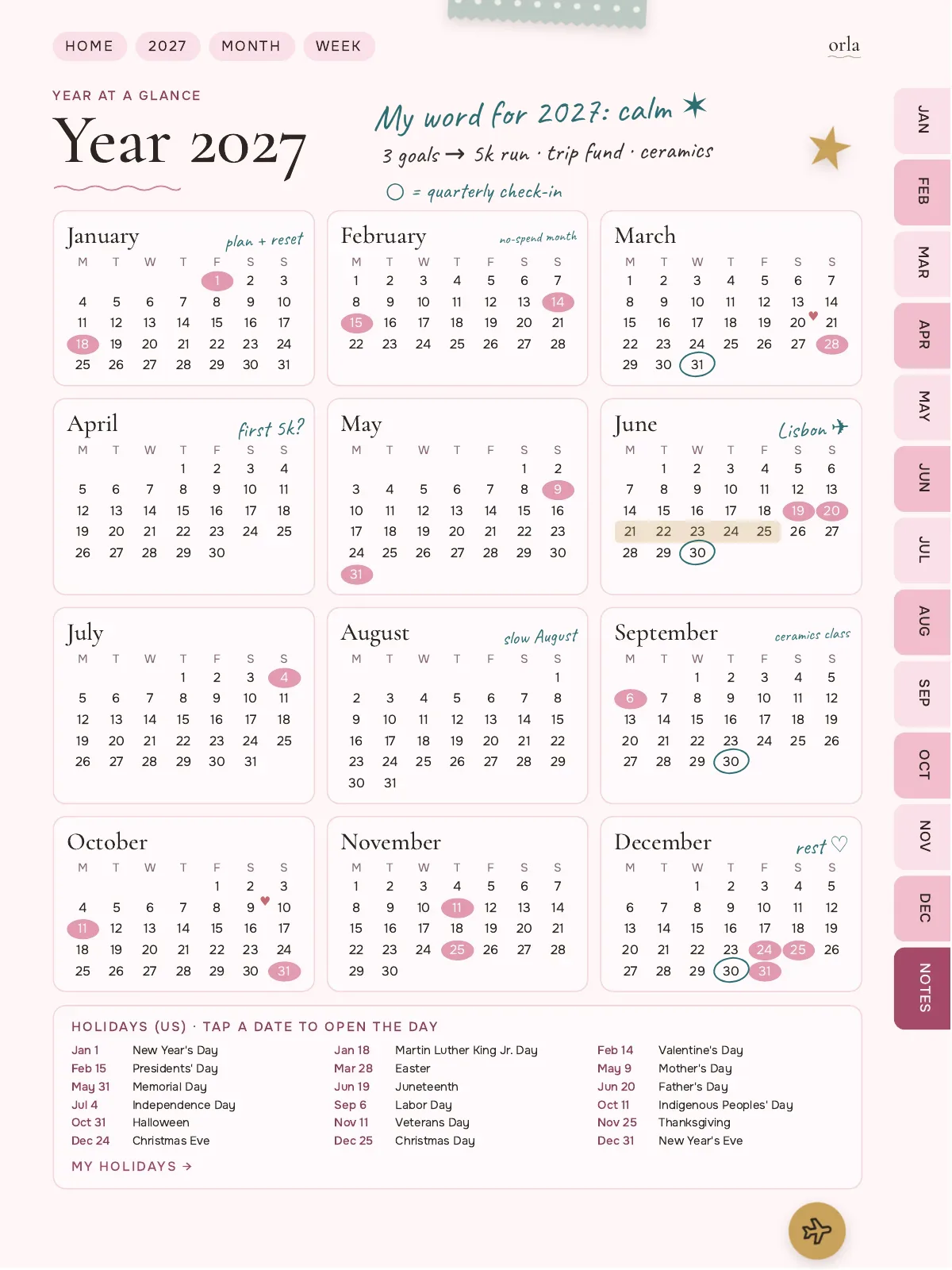
Now open a year-at-a-glance page and mark everything you already know:
- holidays and long weekends,
- birthdays and anniversaries,
- trips and vacations,
- big work deadlines and busy seasons,
- the months that drained you this year (from step 1).
Then place your goals on the map. A trip in June means the savings goal needs to be done by then. A busy September is not the month to start a new course. Seeing the whole year on one page makes these conflicts obvious before they happen.
Add a short note to a few months — a theme rather than a task: "reset", "no-spend month", "slow August". It gives each season a direction without turning it into a to-do list.
Step 5. Break January down (15 minutes)
A year plan becomes real when it reaches your week. Take each goal and ask: what is the smallest piece I can do in January?
- Run 5k → three short runs a week, starting with 20 minutes.
- Trip fund → set up an automatic transfer on payday.
- Ceramics course → find a studio and sign up.
Write those steps into your January monthly page and the first week. Everything else can wait.
Step 6. Schedule the check-ins (5 minutes)
Goals are not set once. They are adjusted. Circle four dates in your year — the end of March, June, September and December — and treat them as meetings with yourself.
At each check-in, spend 20 minutes on three questions: What moved? What got stuck and why? What is the one change for the next three months? It is completely fine to drop a goal that no longer fits. That is not failure, it is good planning.
Between the big check-ins, a short weekly review keeps everything on track.
Keep it light
A good year plan fits on two pages: one with your goals, one with the map of the year. If it needs more, it is probably a wish list. Leave white space in your calendar — the best parts of the year are often the ones nobody planned.
The Orla Digital Planner 2027 has both pages ready: Goals by area right after the Wheel of Life, and Year 2027 with holidays already marked and every date linked to its day. Open it on a quiet evening this month, and January will feel much lighter.