
Journal · Goals
The Wheel of Life — a 15-minute check-in for your whole year
A simple way to see which areas of your life need attention before you set goals. How the wheel works, how to score it honestly and what to do with the result.
October 30, 2026 · 3 min read
 Save
Most goal lists are written in one area of life — usually work or money — while the rest quietly waits. The Wheel of Life helps you look at everything at once before you decide where to put your energy.
The idea is often credited to Paul J. Meyer, who used it in his coaching programmes in the 1960s. It has survived because it is simple: one circle, eight areas, one honest number for each.
The eight areas
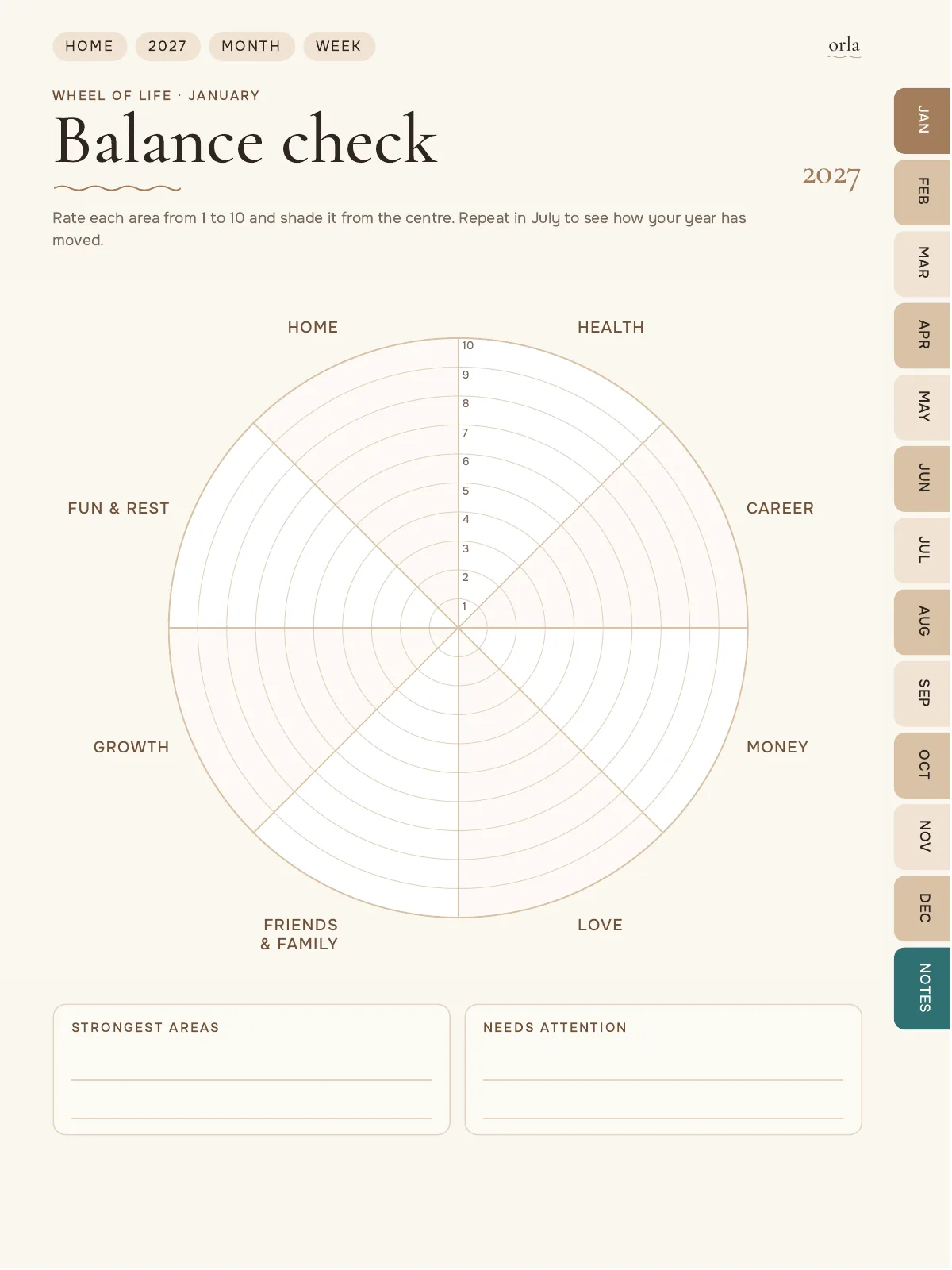
You can adapt them, but a common set is:
- Health — sleep, movement, food, energy
- Career — work, studies, the sense of growing
- Money — income, savings, how calm you feel about finances
- Love — partner, or your relationship with being single
- Friends and family — the people you can call
- Growth — learning, reading, new skills
- Fun and rest — hobbies, holidays, time that is just yours
- Home — the place you live and how it feels to come back to it
How to score it
Draw a circle and divide it into eight slices, or use a ready page. For each area, ask one question: how satisfied am I with this right now, from 1 to 10? Shade each slice from the centre outwards up to your number.
Three rules make the result useful:
- Score today, not your best month. The wheel is a snapshot, not a CV.
- Use your own standard. A 7 in money does not mean a certain salary; it means you feel 7 out of 10 calm about it.
- Do it fast. Five minutes for the scores. Long thinking usually makes people round everything up to 6.
Reading the result
Look at the shape, not only the numbers. A wheel with all 6s rolls smoothly. A wheel with 9 in career and 3 in health does not — and you probably feel that bump every week.
Write down two things:
- Strongest areas — what already works. Keep doing it.
- Needs attention — one or two areas with the lowest scores, or the ones that bother you most. Not all of them.
From the wheel to goals
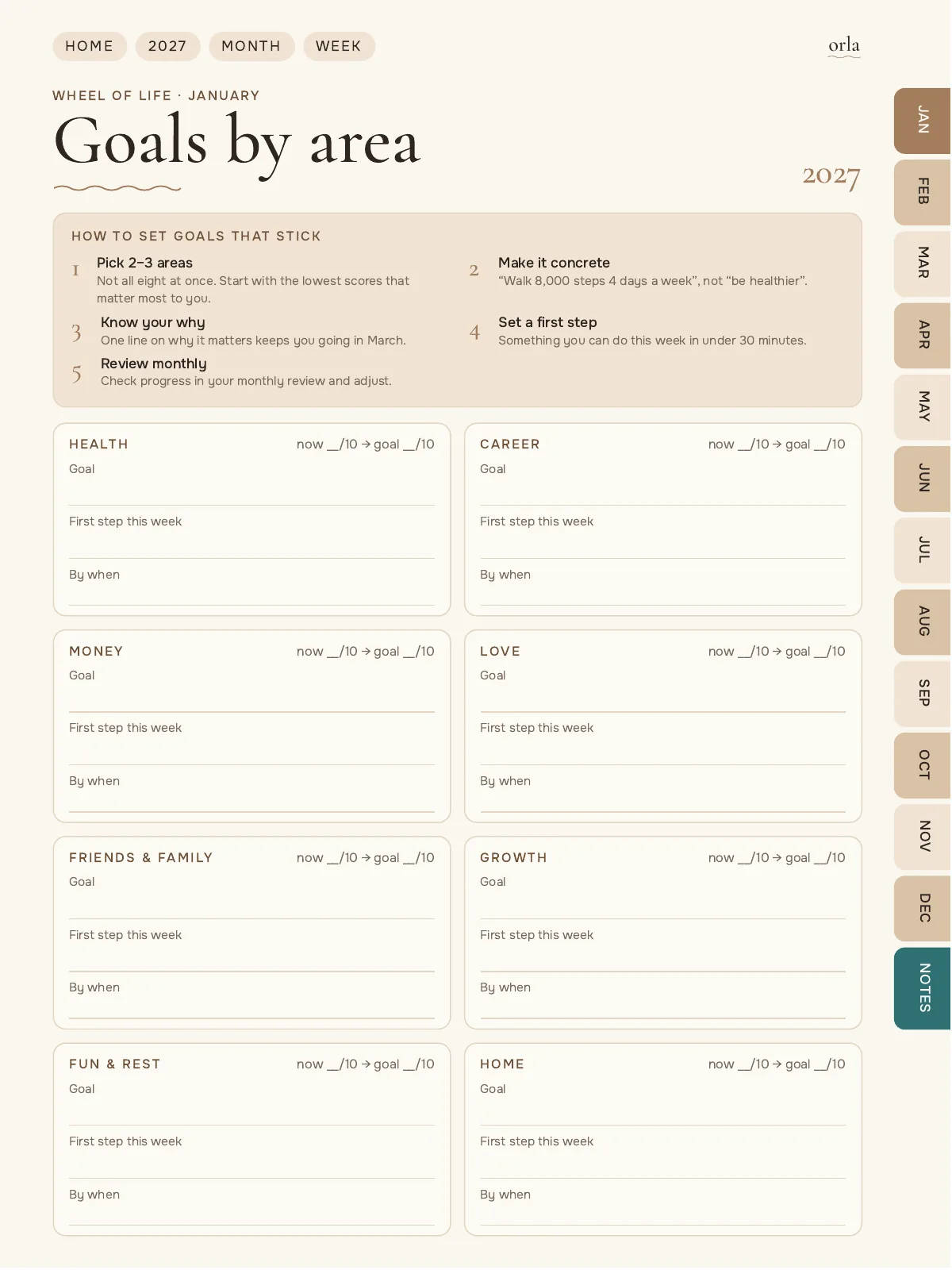
For each area that needs attention, answer three short questions:
- What would a 7 look like? Not a 10. Describe a realistic next step, for example “I sleep 7 hours on most weeknights”.
- Why does it matter? One sentence. This is what you will reread in March.
- What is the first step this week? Something you can do in under an hour: book the appointment, set the alarm for bedtime, open a savings account.
That is enough for one quarter. Two areas, two small goals, two first steps.
Repeat it
The wheel works best as a habit. Do it in January, again in July, and compare. The change in shape tells you more than any list of resolutions: you see which efforts actually moved something and which areas quietly dropped.
In the Orla planner
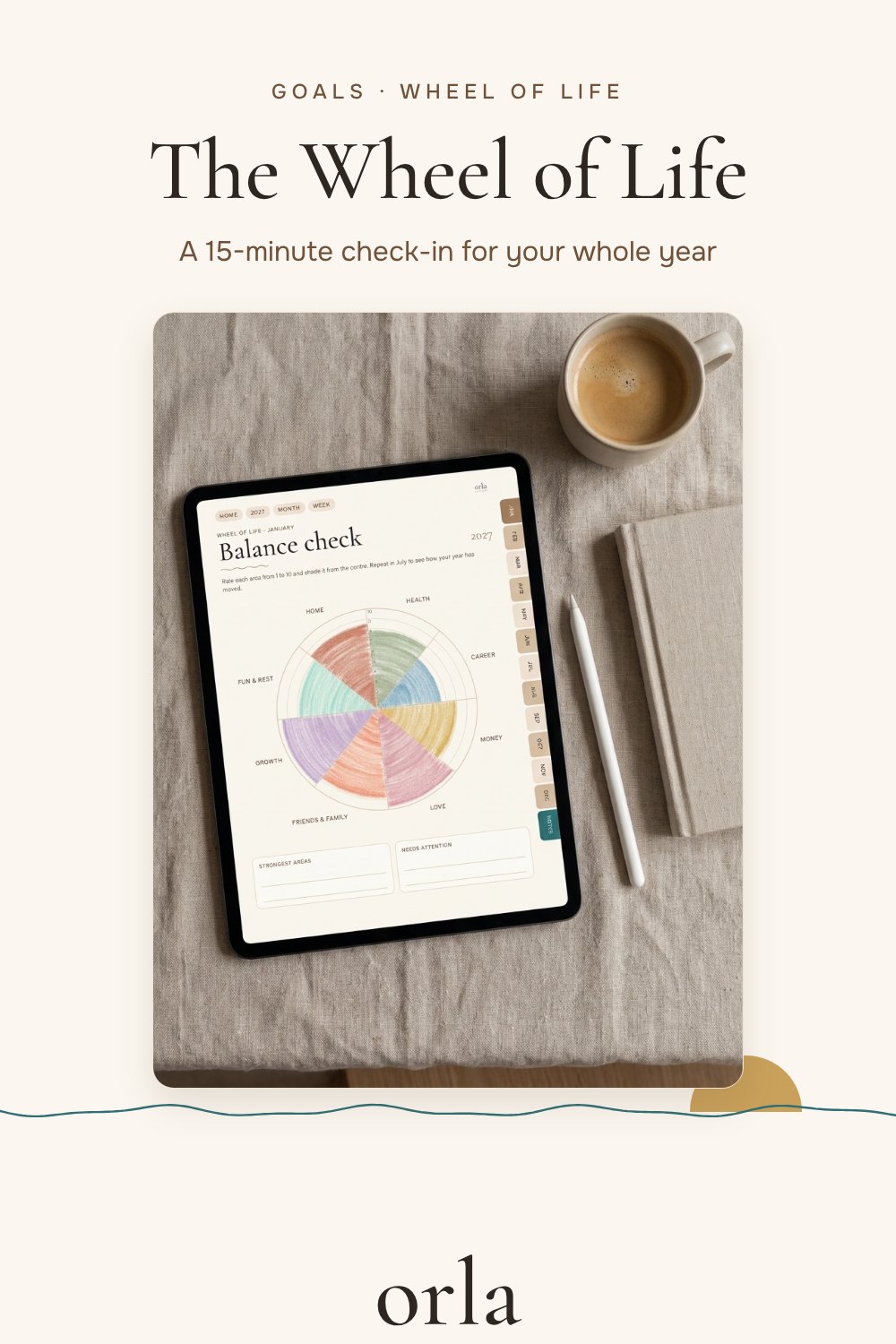
The Orla 2027 planner has a Balance check page with the wheel already drawn and a Goals by area page next to it: goal, why it matters, first step this week and a “by when” date for each of the eight areas. A reminder in July brings you back to it.